



What Is Hot Melt Adhesive?
Introduction
In modern manufacturing, choosing the right adhesive solution directly affects production efficiency, product quality, and long-term performance. Among different bonding technologies, hot melt adhesive has become one of the most widely used industrial adhesives because of its fast bonding speed, clean application process, and compatibility with automated production systems.
Unlike traditional water-based or solvent-based adhesives, hot melt adhesives are applied in a molten state and form a bond after cooling. This unique working principle allows manufacturers to achieve rapid assembly, reduce processing time, and improve production efficiency.
Today, hot melt glue are widely used in industries including packaging, woodworking, furniture manufacturing, automotive components, electronics assembly, bookbinding, and many other industrial applications. For manufacturers looking for a reliable bonding solution, understanding what hot melt adhesive is, how it works, and how to choose the right formulation is essential.
What Is Hot Melt Adhesive?
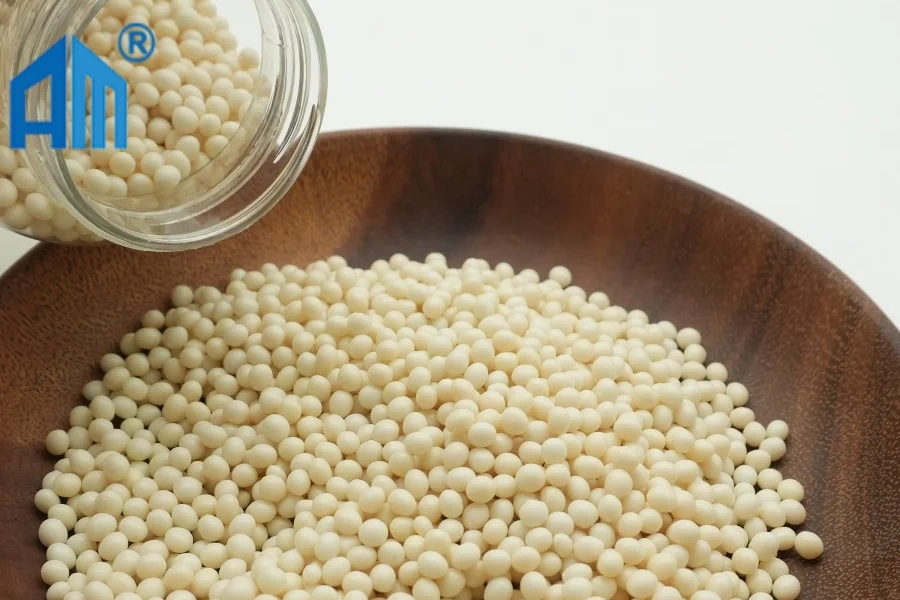
Hot melt adhesive (HMA), also known as hot melt glue, is a type of thermoplastic adhesive that is solid at room temperature and becomes liquid after heating. 100% solid content, zero solvent/water, VOC emission ≤50 mg/m³, fully compliant with GB/T 30776-2021 environmental standards.
The bonding process is based on a simple principle:
- The adhesive is heated until it melts.
- The molten adhesive is applied to the surface of the materials.
- The adhesive cools and solidifies, creating a strong bond.
Unlike solvent-based adhesives, hot melt adhesives usually contain no water or solvent that needs to evaporate during curing. Instead, bonding occurs through physical cooling and solidification of the polymer structure.
This characteristic gives hot melt adhesives several advantages:
- Fast setting speed
- High production efficiency
- Clean processing
- Easy automation
- Long storage stability
Because the adhesive does not require drying time, manufacturers can significantly shorten production cycles compared with many traditional adhesive systems.
How Does Hot Melt Adhesive Work?
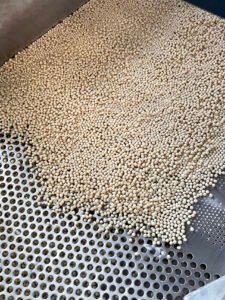
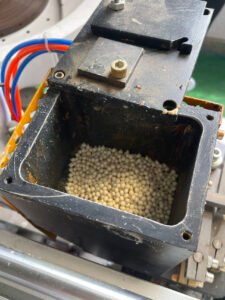
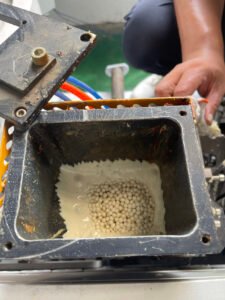
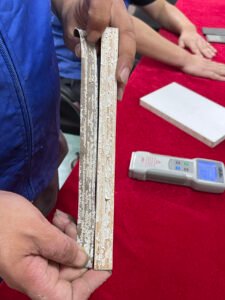
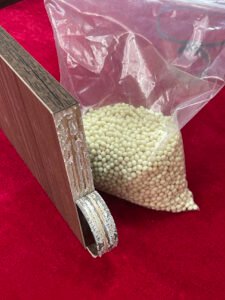
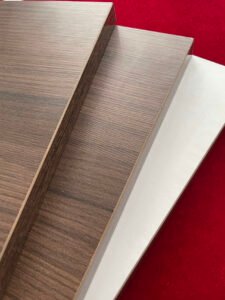
Understanding how hot melt glue works helps manufacturers select the right product and optimize production conditions.
1. Heating and Melting
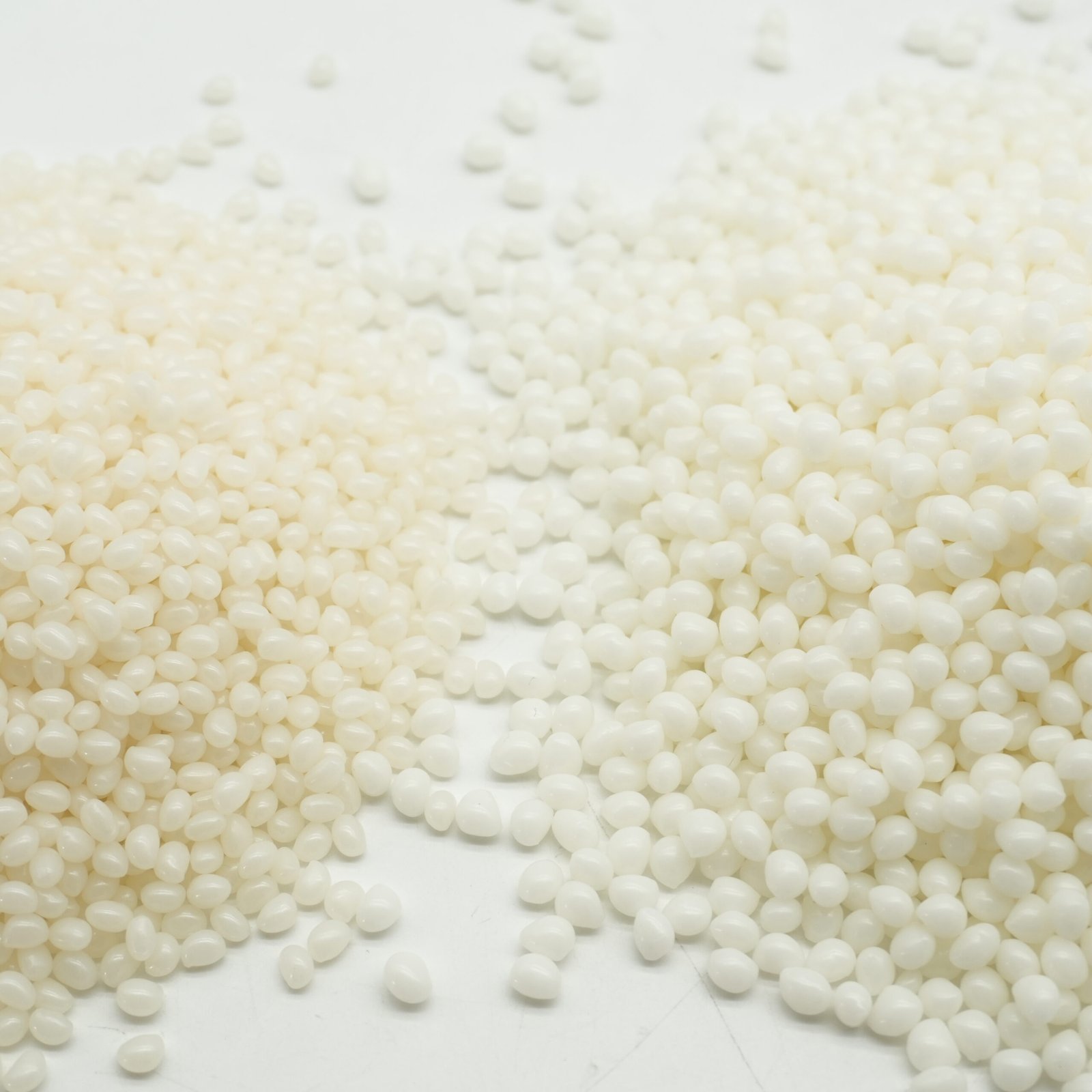
Hot melt adhesive is normally supplied as:
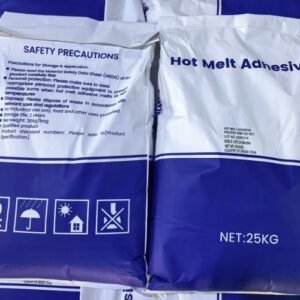
- Granules (25kg standard packaging)
- Pellets
- Blocks
- Sticks(7mm/11mm diameter standard size)
During production, the adhesive is heated inside equipment such as a melting tank or hot melt applicator.
The heating temperature depends on the adhesive formulation and application requirements. Different hot melt adhesives are designed with different melting points, viscosity ranges, and processing windows.
| Resin Type | Recommended Melting Temp | Melt Viscosity Range | Complete Melting Time (150℃ tank) |
| EVA General Purpose | 140–180℃ | 3,000–10,000 mPa·s @160℃ | 5–10min |
| Polyolefin (PO) | 160–200℃ | 6,000–15,000 mPa·s @180℃ | 8–12min |
| Polyamide (PA High Temp) | 180–220℃ | 2,000–15,000 mPa·s @200℃ | 10–15min |
| PUR Reactive Hot Melt | 120–160℃ | 1,500–2,500 mPa·s @150℃ | 4–8min |
2. Application to Substrates
After melting, the adhesive is applied through different methods:
- Roller coating
- Spray application
- Slot coating
- Nozzle dispensing
The application method depends on the production process and the materials being bonded. Standard industrial coating dosage data:
- Carton sealing: 15–30 g/m bead
- Furniture edge banding: 180–250 g/m² coating area
- Book spine binding: 120–200 g/m²
- Electronic component dispensing: 0.05–0.2 g per dot
For example:
- Packaging manufacturers may use high-speed automatic application systems.
- Furniture manufacturers may use roller systems for panel assembly and edge-related applications.
- Industrial assembly lines may use precision dispensing equipment.
3. Cooling and Bond Formation
Once applied, the adhesive begins cooling and solidifying.
The bonding strength depends on several factors:
- Surface compatibility
- Adhesive formulation
- Application temperature
- Pressure
- Cooling conditions
This means choosing the correct hot melt glue is not only about the adhesive itself but also about matching the adhesive with the production environment.
What Are Hot Melt Adhesives Made Of?
Hot melt adhesive is not a single material. It is a formulated system containing different components that work together to achieve specific performance, with standard mass proportion range:
- Polymer Base: 40%–60%
- Tackifying Resin: 30%–45%
- Wax & Functional Additives: 5%–15%
A typical hot melt adhesive formulation may include:
1. Polymer Base
The polymer provides the main structure and bonding characteristics. Common polymer bases + quantitative performance comparison:
| Polymer Base | Softening Point | Core Strength Data | Suitable Scenarios |
| EVA (Ethylene Vinyl Acetate) | 70–120℃ | Shear strength 1.5–2.2MPa, low cost | Packaging, low-speed furniture, glue sticks |
| Polyolefin (PO) | 130–150℃ | Peel strength ≥6 N/cm, low odor | Automotive interior, PP/PET plastic bonding |
| Polyamide (PA) | 120–180℃ | Heat resistance up to 120℃ continuous use | Electronics, auto engine peripheral parts |
| PUR Reactive Polyurethane | 120–140℃ | Final tensile strength 8–12MPa, irreversible bond | High-end furniture, bookbinding, automotive |
Among these, EVA is one of the most commonly used materials because it provides a good balance between adhesion performance, processing stability, and cost efficiency.
2. Tackifying Resin
- Tackifiers improve:Initial adhesion (ring tack test ≥4N standard industrial grade)
- Wetting ability ·
- Bonding performance
They help the adhesive quickly establish contact with the substrate surface.
3. Wax and Additives
Other components may be added to control: ·
- Melt viscosity
- Open time (industry range: 2–60s)
- Flexibility
- Heat stability
- Processing performance
Different formulations are developed according to different industrial requirements. For example, an adhesive designed for fast automated production may require open time ≤5s, while flexible packaging glue needs open time 15–25s.
Types of Hot Melt Adhesive
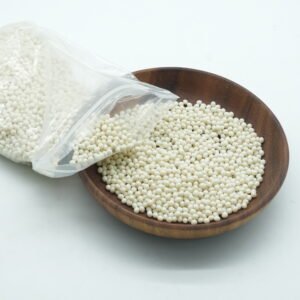
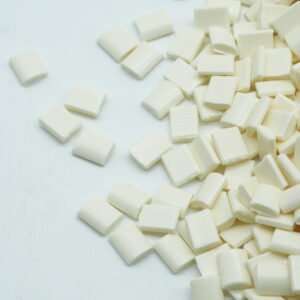
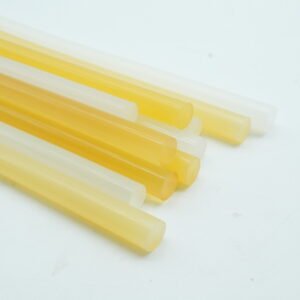
Hot melt adhesives are available in different forms and are designed for various industrial applications. The most common types include edge banding hot melt adhesive, bookbinding hot melt adhesive, and hot melt glue sticks.
1. Edge Banding Hot Melt Adhesive
Edge banding hot melt adhesive is mainly used in furniture manufacturing and woodworking applications. It is designed to bond edge banding materials to MDF, particle board, plywood, and other wood-based panels.
Key features include:
- Fast bonding speed
- Stable processing performance
- Good adhesion
- Suitable for automatic edge banding machines
It is widely used in:
- Cabinets
- Wardrobes
- Office furniture
- Panel furniture
2. Bookbinding Hot Melt Adhesive
Bookbinding hot melt glue is commonly used in the printing and publishing industry for books, catalogs, magazines, and notebooks.
It provides:
- Strong paper bonding
- Flexible binding performance
- Fast production efficiency
Because it does not require long drying time, it is suitable for high-speed automated bookbinding production.
3. Hot Melt Glue Sticks
Hot melt glue sticks are mainly used for household, craft, and light industrial applications. They are applied with a hot glue gun and are popular because of their simple operation and quick bonding.
Common uses include:
- DIY projects
- Product assembly
- Packaging repair
- Decorative applications
Different hot melt adhesive types are developed for different bonding requirements. Selecting the right adhesive depends on the application, materials, production process, and performance requirements.
Applications of Hot Melt Adhesive
Hot melt adhesive is widely used across different industries because of its fast bonding speed, clean application process, and compatibility with automated production systems.
From furniture manufacturing to packaging and industrial assembly, hot melt glue provide efficient bonding solutions for manufacturers that require stable performance and high production efficiency.
1. Furniture Manufacturing and Woodworking
The furniture industry is one of the most common application areas for hot melt adhesive.
Manufacturers use hot melt adhesives for various woodworking processes, including:
- Edge banding
- Panel assembly
- Decorative material bonding
- Furniture component assembly
In modern furniture production, especially with automated equipment, adhesive performance directly affects production efficiency and final product quality.
A suitable hot melt adhesive helps manufacturers achieve:
- Strong and durable bonding
- Clean glue lines
- Fast production cycles
- Consistent product appearance
For edge banding applications, the adhesive needs to work effectively with different materials, including:
- MDF
- Particle board
- Plywood
- PVC edge bands
- ABS edge bands
- Melamine edge bands
Different production environments may require different adhesive characteristics, such as viscosity, open time, and heat resistance.
2. Packaging Industry
Packaging is another major application field for hot melt adhesives.
They are commonly used in:
- Carton sealing
- Corrugated packaging
- Product packaging assembly
- Label bonding
The packaging industry often requires adhesives that can support high-speed production lines. Because hot melt adhesives create bonds quickly after cooling, they allow manufacturers to improve production efficiency and reduce waiting time.
Compared with traditional liquid adhesives, hot melt glue provide advantages such as:
- Faster setting speed
- No drying process
- Cleaner production
- Easy automation
This makes them suitable for modern packaging operations where speed and reliability are important.
3. Bookbinding Industry
Hot melt adhesive plays an important role in book and printing production.
Applications include:
- Paperback books
- Catalogs
- Manuals
- Notebooks
- Magazines
Bookbinding manufacturers choose hot melt adhesive because it provides a balance between strong adhesion and flexibility.
A suitable bookbinding adhesive should provide:
- Good paper compatibility
- Flexible spine bonding
- Fast processing speed
- Stable performance during storage
With the growth of digital printing and customized publishing, efficient adhesive solutions have become increasingly important for short-run and high-volume book production.
4. Automotive and Industrial Applications
Hot melt adhesives are also used in automotive and industrial manufacturing.
Common applications include:
- Interior component assembly
- Fabric bonding
- Filter manufacturing
- Insulation materials
- Protective components
Industrial manufacturers choose hot melt glue because it can support automated assembly processes while maintaining consistent bonding quality.
In these applications, adhesive selection usually depends on:
- Material compatibility
- Temperature requirements
- Mechanical performance
- Production conditions
Why Do Manufacturers Choose Hot Melt Adhesive?
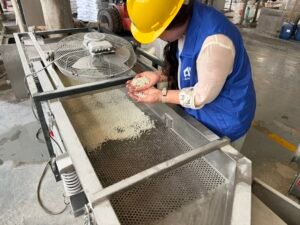
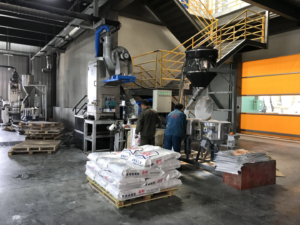

The popularity of hot melt adhesive comes from its combination of efficiency, convenience, and performance advantages.
Fast Bonding and High Production Efficiency
One of the biggest advantages of hot melt adhesive is its rapid bonding process.
Unlike many traditional adhesives that require drying or curing time, hot melt adhesive forms a bond mainly through cooling.
This allows manufacturers to:
- Increase production speed
- Reduce waiting time
- Improve manufacturing efficiency
For automated production lines, fast bonding is especially valuable because it helps maintain continuous operation.
Solvent-Free and Cleaner Processing
Many hot melt adhesives are solvent-free adhesive solutions.
This provides several benefits:
- Reduced VOC emissions
- Cleaner working environment
- Easier storage and transportation
- Lower environmental impact
As industries continue to focus on sustainable manufacturing, solvent-free adhesive technologies are becoming increasingly important.
Suitable for Automated Manufacturing
Modern factories increasingly rely on automation, and hot melt glue is well suited for automated application systems.
It can be applied through:
- Roller coating equipment
- Glue dispensing machines
- Spray systems
- Automatic production lines
Stable viscosity and consistent melting performance help manufacturers maintain reliable production quality.
Long Storage and Easy Transportation
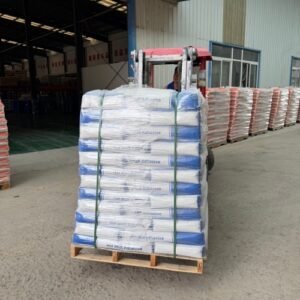
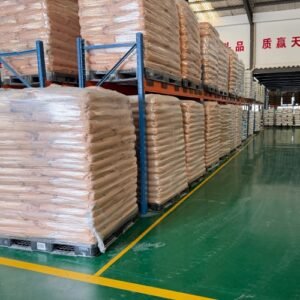
Because hot melt adhesives are usually supplied in solid form, they offer advantages during storage and transportation.
Compared with liquid adhesive systems, hot melt adhesives generally have:
- Less risk of leakage
- Convenient packaging
- Better storage stability
This makes them suitable for both domestic supply and international export.
How to Choose the Right Hot Melt Adhesive?
Choosing the right hot melt adhesive is an important decision for manufacturers because adhesive performance directly affects production efficiency, product quality, and long-term bonding reliability.
Different applications require different adhesive characteristics. A suitable adhesive should match the materials, equipment, and production conditions.
1. Consider the Bonding Materials
The first factor to consider is the type of materials that need to be bonded.
Different substrates have different surface properties, which can influence adhesive performance.
Common materials used with hot melt adhesives include:
- Wood-based panels
- Paper and cardboard
- Plastic materials
- Fabric
- Composite materials
For example, furniture manufacturers may require an adhesive with good compatibility for wood panels and edge banding materials, while packaging manufacturers may focus more on fast setting speed and strong paper adhesion.
2. Match the Adhesive with Production Equipment
Production equipment is another important factor when selecting hot melt glue.
Manufacturers should consider:
- Application method
- Machine speed
- Working temperature
- Glue application amount
For automated production lines, adhesive stability is especially important. If the adhesive viscosity changes significantly during operation, it may affect:
- Glue application quality
- Bonding strength
- Production consistency
A professional adhesive supplier can provide technical recommendations based on specific equipment conditions.
3. Evaluate Performance Requirements
Different applications may require different adhesive properties.
Important performance factors include:
Adhesion Strength
The adhesive should create a reliable bond between different materials.
Temperature Resistance
For products used in high-temperature environments, heat resistance is an important consideration.
Flexibility
Some applications require adhesives that can maintain bonding performance while allowing material movement.
Processing Stability
Stable melting behavior and viscosity help ensure consistent manufacturing results.
Common Problems When Using Hot Melt Adhesive
Although hot melt adhesives are easy to process, incorrect adhesive selection or production settings may affect bonding results.Understanding common problems can help manufacturers improve application performance.
Why Does Hot Melt Glue Have Weak Bonding Strength?
Possible reasons include:
- Incorrect adhesive selection
- Insufficient heating temperature
- Poor surface condition
- Incorrect application amount
- Insufficient pressure during bonding
To improve bonding performance, manufacturers should check both adhesive properties and production parameters.
Why Does Adhesive Not Melt Properly?
Hot melt adhesive requires suitable heating conditions.
Possible causes include:
- Low operating temperature
- Incorrect equipment settings
- Insufficient melting time
Maintaining the recommended processing temperature helps ensure stable adhesive performance.
Why Does Edge Banding Come Off?
In furniture applications, edge separation may happen due to:
- Poor material compatibility
- Incorrect adhesive type
- Low glue application amount
- Improper machine settings
Selecting the correct edge banding hot melt adhesive and optimizing machine parameters can significantly improve bonding reliability.
Frequently Asked Questions
How should hot melt adhesive be stored?
Hot melt adhesive should be stored in a dry and clean place, away from moisture, direct sunlight, and excessive heat. Keeping the adhesive in its original packaging helps maintain stable performance before use.
Does hot melt glue have a shelf life?
Yes. Hot melt adhesive has a recommended shelf life depending on its formulation and storage conditions. Proper storage helps maintain its bonding performance and processing stability.
Can hot melt glue be customized?
Yes. Hot melt adhesive can be customized according to different application requirements, including bonding materials, viscosity, processing temperature, and production conditions.
What factors affect hot melt glue performance?
Adhesive performance is affected by factors such as material compatibility, application temperature, machine settings, adhesive amount, and production environment.
Can customers test hot melt adhesive before ordering?
Yes. Sample testing is recommended before bulk production. It helps customers evaluate bonding performance and confirm whether the adhesive matches their materials and production process.
What packaging options are available for hot melt adhesive?
Hot melt adhesive is available in different packaging formats according to product type and customer requirements. Export packaging can also be provided for international shipments.
What is the MOQ for customized hot melt adhesive?
The MOQ depends on the adhesive type, customization requirements, and order volume. Customers can discuss their application needs with suppliers to determine a suitable quantity.
How long does customized hot melt adhesive production take?
Production time depends on the formula requirements and order quantity. The process usually includes requirement confirmation, sample testing, and production after approval.
What information is needed to select the right hot melt adhesive?
Customers should provide information about the application, bonding materials, equipment, and performance requirements. This helps suppliers recommend the most suitable adhesive solution.
How do I choose a reliable hot melt adhesive manufacturer?
A reliable manufacturer should provide stable product quality, technical support, customization capability, and consistent supply for long-term cooperation.
Conclusion
Hot melt adhesive has become an important bonding technology for modern manufacturing because of its fast processing speed, clean application, and compatibility with automated production.
From furniture manufacturing and edge banding to packaging and bookbinding, different industries rely on hot melt adhesives to improve production efficiency and maintain consistent bonding quality.
Choosing the right adhesive requires considering factors such as materials, equipment, processing conditions, and performance requirements.
For manufacturers looking for a reliable hot melt glue solution, working with an experienced supplier can provide benefits including product customization, technical support, and stable supply.